
NECK-CERVICAL SPINE PROBLEMS
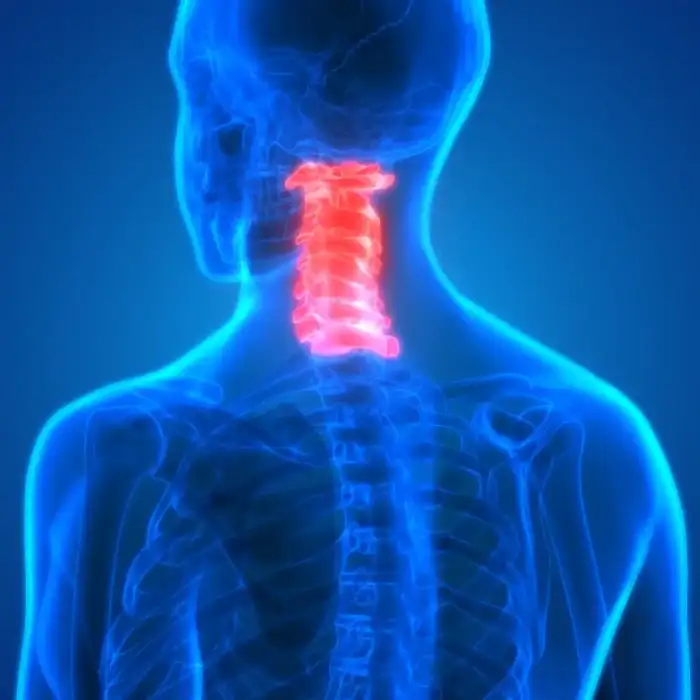
Cervical disc herniation, also known as cervical disc herniation, occurs when the contents of the disc structures between the vertebrae are displaced towards the part of the spinal cord or nerve roots. Cervical disc herniation often causes a picture called radiculopathy, which is accompanied by neck pain, pain radiating to the arm, numbness in the arms, as well as sensory, motor and reflex changes. Approximately a quarter of patients may develop myelopathy, in which the spinal cord develops malnutrition and structural changes. This condition manifests itself with signs of spinal cord damage such as weakness in the arms and legs, sensory loss and difficulty walking. Cervical disc herniation is generally a disease with a good prognosis. Patients should primarily be treated conservatively. Conservative treatment includes rest, cervical collar, painkillers and muscle relaxants, as well as transforaminal steroid injection and facet joint blockage to relax the nerve roots.
In the case of spinal cord damage, called myelopathy, the problem is often canal stenosis rather than a herniated disc. This disease, called cervical spondylosis, occurs at a later age than herniated discs. Since pain is not at the forefront in this disease, neurological findings can be recognized by the patient when they reach an advanced level. For this reason, neurological findings called pyramidal findings should be examined in patients with neck pain.
The aim of surgical treatment is to remove the part of the disc that is pressing on the nerve. In this surgery, the compressing disc is removed from the front of the neck. The spinal cord in the midline and the canal of the compressed nerve to the arms on the sides are widened. In addition, if there are sharpenings called osteophytes on the bone edges, these are shaved and the procedure called decompression is completed. The procedure is then completed with two different techniques;
Fusion and Stabilization
Fusion of the vertebrae after decompression is a common procedure. The removed disc is replaced with an implant filled with a material that accelerates fusion. This implant not only accelerates fusion but also maintains the height of the removed disc area. A metal plate is then placed in front of the vertebrae and fixed to the vertebrae with screws to stabilize them.
Cervical Disc Prosthesis
Another treatment option applied in our center is disc prosthesis applications, which are preferred especially in young patients in order to preserve movement. Disc prostheses, which can be applied to one or several distances, provide an advantage in terms of reducing the risk of developing a problem in neighboring distances in the following years.
In the case of canal stenosis and myelopathy, relief surgeries are performed from the front, back or both sides, depending on the degree of compression and on which side it is more severe. After the nerve and spinal cord structures are relieved, an implant is placed that supports the cervical vertebrae and allows them to fuse in the appropriate position.
Surgical treatment may involve surgery on the front (anterior), back (posterior) or both sides of the neck. To determine the type of surgery to be performed, some factors must first be examined. The compression points in the spinal cord or nerve roots are identified, and the level of compression is determined. The presence of malnutrition and myelomalacia in the spinal cord are taken into account. The alignment of the cervical vertebrae is also important in treatment planning. In particular, kyphosis, or forward angulation, is a decisive problem in treatment planning.
Anterior surgery
If the surgery is to be performed on the front of the neck, an incision is made on the front of the neck. The tissues are removed to the sides and the cervical vertebrae are accessed. The discs and vertebrae compressing the nerve root are removed. Bone fragments from the bone bank or from the removed vertebrae are placed in an implant and this implant is placed between the two vertebrae. The two vertebrae are fixed together with a metal plate and screws. Posterior surgery There are two types of surgery performed from the back of the neck.
Laminectomy+Stabilization
When surgery is performed from the back of the neck, an incision is made and the back of the spine is accessed through the nape muscles. First, screws are placed at the levels determined according to radiological findings and these are connected with a metal rod. After stabilization is achieved, the bony protrusions pressing on the spinal cord and nerve roots are removed with a high-speed milling cutter and the procedure called laminectomy is completed.
Laminoplasty
The posterior elements of the vertebrae are cut completely on one side and only the outer parts are weakened on the opposite side. From the cut side, the posterior elements of the spine are lifted in a hinge. After the spinal cord is relieved with this maneuver, it is fixed with mini-plates and screws while maintaining this position.